

GCC Market Entry Strategy for Skincare Brands: A Practical Guide to Entering the Gulf
Primary SEO keyword: GCC market entry strategy
Meta description: Explore how skincare brands can enter the GCC market, assess six Gulf countries, evaluate distributors, prepare for regulatory requirements, and build a commercially viable expansion strategy.
Introduction: Why GCC Expansion Requires a Country-by-Country Strategy
The Gulf Cooperation Council (GCC) offers opportunities for international skincare brands seeking to expand beyond their existing markets. However, entering the Gulf successfully requires more than identifying a growing beauty category or appointing a distributor.
A sound GCC market entry strategy begins with a clear understanding of the brand's proposition, target customers, competitive position, regulatory obligations, distribution options, and commercial objectives.
The GCC comprises six countries: Saudi Arabia, the United Arab Emirates (UAE), Qatar, Kuwait, Bahrain, and Oman. Although these markets share regional connections, they differ in customer preferences, retail structures, competitive conditions, and operating requirements.
A strategy that works in the UAE may not produce the same results in Saudi Arabia or Kuwait. Brands must therefore distinguish regional coordination from country-specific execution.
For skincare businesses, the objective is not simply to enter more countries. It is to identify the most commercially suitable market, establish a viable route to customers, and build evidence that supports further investment.
This guide explains how to assess GCC markets, select an entry model, prepare for product compliance, evaluate distribution partners, and develop a structured expansion plan.
- Understand the GCC Skincare Market Before Choosing a Country
Before committing resources, skincare brands should assess whether their products, pricing, positioning, and distribution model are suited to the markets they intend to enter.
The first step is to define the opportunity rather than assume that regional demand automatically translates into demand for a particular product.
Define Your Target Customer
Start by identifying the customer group most likely to purchase your products.
Relevant considerations include:
- Age range, purchasing behaviour, and skincare routines.
- Skin concerns and product preferences.
- Interest in premium, clinical-positioned, natural, or everyday skincare.
- Preferred purchasing channels, including pharmacies, beauty retailers, marketplaces, and direct-to-consumer websites.
- Price sensitivity and expectations regarding product quality.
- Language preferences and the type of product education customers require.
These factors influence both the choice of market and the commercial strategy.
For example, a premium skincare brand may need a different distribution approach from an accessible daily skincare line. One may depend on specialist retailers and professional product education, while the other may rely more heavily on e-commerce, repeat purchases, and broad retail availability.
These are hypotheses to validate through market research, not assumptions to apply uniformly across the GCC.
Assess the Competitive Landscape
Evaluate the brands already serving your intended customer segment.
Research should cover:
- Direct and indirect competitors.
- Product formats, ingredients, and positioning.
- Retail and online availability.
- Local pricing and promotional activity.
- Customer reviews and recurring product complaints.
- Distribution relationships and visibility across relevant channels.
A crowded category does not automatically indicate that a market is unsuitable. It may demonstrate established consumer demand. The commercial question is whether your brand can offer a differentiated proposition and reach customers at an economically viable cost.
Test the Commercial Opportunity
Before committing to a full launch, investigate whether potential customers, distributors, and retailers have a credible reason to choose your brand.
Useful evidence includes qualified buyer discussions, competitor price comparisons, retailer requirements, distributor interest, customer research, and realistic unit economics.
Distinguish between general interest and commercial commitment. A positive conversation is not equivalent to a purchase order, and a purchase order does not guarantee timely payment or repeat demand.
The objective is to reduce uncertainty before increasing investment.
- Compare the Six GCC Countries
Choosing the right entry market is one of the most consequential decisions in a GCC expansion plan.
Each country should be assessed against consistent criteria, including category demand, competition, distribution access, regulatory requirements, operating costs, and the resources required to support the launch.
Saudi Arabia
Saudi Arabia is a major market to evaluate for skincare brands seeking a substantial consumer opportunity in the Gulf.
The assessment should consider the brand's target audience, category positioning, relevant retail channels, competitive intensity, and ability to support local distribution and customer acquisition.
Before launch, brands should identify the applicable product notification or registration requirements, responsible parties, documentation, labelling obligations, and any other requirements relevant to their products and operating model.
The Saudi market may be attractive for brands with a clear value proposition and a credible route to distribution. However, market size alone does not establish that a specific product will succeed.
Key question: Can the brand reach a defined customer segment through an appropriate channel while maintaining commercially sustainable margins?
United Arab Emirates
The UAE can be a useful market to assess for brands considering regional distribution, premium beauty retail, e-commerce, and access to an internationally diverse consumer base.
Dubai and other emirates offer different commercial environments and potential routes to customers. The appropriate strategy depends on the brand's positioning, target audience, channel requirements, and local operating arrangements.
Brands should evaluate the relevant business licensing structure separately from product-specific requirements. Establishing a company does not automatically satisfy all obligations associated with selling cosmetics or skincare products.
The UAE may be suitable as an initial market when the brand has a credible route to customers and can meet the applicable compliance and operational requirements.
Key question: Does the UAE offer the right combination of customer access, distribution opportunities, and operating economics for the brand?
Qatar
Qatar should be evaluated according to the brand's target segment, category demand, retail access, and potential commercial partners.
For some brands, a focused distribution strategy may be more appropriate than a broad launch. The suitability of this approach depends on the product category, available channels, pricing, and partner capabilities.
Brands should validate retailer requirements, product documentation, local import arrangements, and applicable compliance obligations before committing to commercial activity.
Key question: Is there a clearly defined customer or distribution opportunity that justifies entering Qatar independently?
Kuwait
Kuwait is another market worth assessing for brands targeting specific skincare customer segments and retail channels.
Research should examine competing products, local price positioning, distributor relationships, online purchasing options, and the commercial terms required to achieve distribution.
A potential partner should be assessed on more than its existing contacts. Relevant factors include category experience, account access, reporting quality, commercial commitment, and the ability to support the brand after initial placement.
Key question: Can the brand secure credible distribution and a realistic path to repeat sales?
Bahrain
Bahrain may be appropriate for brands seeking a focused market assessment or a distribution opportunity aligned with their category and operating capacity.
Its suitability should be evaluated through actual buyer access, channel economics, customer demand, competition, and the cost of meeting applicable requirements.
Brands should avoid assuming that successful entry into a neighbouring market automatically establishes a viable opportunity in Bahrain.
Key question: Does the market offer sufficient commercial potential relative to the resources required to serve it?
Oman
Oman should be evaluated independently, with attention to customer segments, distribution coverage, retail access, competitive positioning, and logistics.
The appropriate entry strategy may differ according to whether the brand targets specialist beauty channels, pharmacies, general retail, or online customers.
Before selecting a partner, determine which regions and channels the partner can realistically serve and how performance will be measured.
Key question: Can the brand reach its intended customers efficiently while maintaining adequate distribution coverage and margins?
Build a Country Selection Scorecard
Instead of selecting a country based only on general market attractiveness, compare all six markets using a consistent framework.
Suggested criteria include:
- Evidence of demand for the product category.
- Competitive intensity and differentiation opportunities.
- Access to suitable distributors and retailers.
- Product compliance requirements and readiness.
- Pricing, channel margins, and commercial viability.
- Logistics, fulfilment, and customer service.
- Available resources and launch complexity.
- Potential for repeat purchases and sustainable growth.
Assign scores only where supporting evidence exists. Mark unknowns separately rather than treating missing information as a positive result.
The best initial market is the one that offers the strongest combination of validated opportunity, manageable requirements, and a viable route to revenue.
- Prepare for Regulatory and Product Readiness
Regulatory readiness is a critical dependency in skincare market entry.
A brand may have an attractive product and a willing distributor but still be unable to proceed until the applicable product and documentation requirements have been addressed.
Requirements depend on the country, product classification, ingredients, claims, business model, and relevant authorities.
Review Product Documentation
Depending on the product and applicable requirements, documentation may include:
- Complete ingredient lists and INCI nomenclature.
- Product specifications.
- Safety assessments or supporting safety documentation.
- Certificates of analysis and relevant quality documentation.
- Manufacturing and quality-system information.
- Product labels, packaging artwork, and usage instructions.
- Evidence supporting product claims.
- Free sale certificates or other documents where required.
- Applicable manufacturing, origin, or conformity documents.
This list is a preparation framework, not a universal checklist. The actual requirements must be confirmed for each product and destination market.
Review Labels and Product Claims
Labels and marketing materials should be reviewed for the applicable language, ingredient declarations, warnings, usage instructions, product identity, and other mandatory information.
Claims require particular attention.
A cosmetic product should not be marketed with unsupported medical or therapeutic claims. Claims about efficacy, ingredients, clinical performance, or specific skin outcomes should be consistent with the available evidence and the applicable regulatory framework.
Translation alone is not sufficient. Product information should also be understandable to the intended customer and appropriate for the local market.
Plan Compliance Before Setting a Launch Date
Product readiness, documentation review, regulatory submissions, partner onboarding, and commercial preparation may involve separate workstreams.
Their timelines depend on the product and market. Brands should not assume that a fixed registration period applies across all GCC countries.
Build a launch plan that identifies dependencies, responsible parties, required documents, decision points, and potential delays.
Product registration, regulatory submissions, import arrangements, and associated third-party costs should be assigned clearly between the brand and its partners. Responsibilities should be agreed before commercial commitments are made.
- Choose the Right Market Entry Model
A skincare brand needs a route to customers that matches its resources, strategic objectives, and desired level of control.
Several models may be appropriate, but they are not interchangeable.
Distributor Partnerships
A distributor may provide access to local retail relationships, import capabilities, and established sales channels.
Before appointing one, assess:
- Experience with skincare and beauty brands.
- Access to the target retail or pharmacy accounts.
- Geographic and channel coverage.
- Financial and operational capability.
- Existing brand portfolio and potential conflicts.
- Sales reporting and inventory visibility.
- Marketing responsibilities and launch commitments.
- Payment terms and commercial expectations.
The agreement should clarify territory, exclusivity if any, performance obligations, product compliance responsibilities, marketing commitments, and termination conditions.
Exclusivity should be supported by measurable commitments rather than granted solely on the basis of initial interest.
Retail and Pharmacy Partnerships
Direct relationships with retailers or pharmacy groups may be relevant when the brand has a suitable proposition and can meet the channel's requirements.
Retail discussions should cover listing criteria, wholesale pricing, margins, promotional expectations, payment terms, product availability, and potential returns or deductions.
A listing is only one stage of commercial success. The brand must also evaluate sell-through, replenishment, and the economics of supporting the account.
E-Commerce and Marketplaces
E-commerce may provide a route to test product demand and communicate directly with customers.
Possible channels include a brand's own online store and relevant third-party marketplaces, subject to their requirements and the applicable local rules.
A viable e-commerce model needs more than a functioning website. It requires suitable product information, competitive pricing, customer acquisition, fulfilment, payment options, service, and repeat-purchase planning.
Marketplaces should be evaluated individually. Platform availability, seller eligibility, product restrictions, fees, logistics, and local operating requirements can differ.
Direct Market Presence
A local company or direct operating structure may provide greater control over commercial relationships and execution.
However, it can also introduce additional costs and administrative responsibilities.
Before establishing a local entity, compare the benefits of direct presence against the alternatives available through distributors, service providers, or other compliant operating arrangements.
Company formation should support a validated commercial strategy rather than substitute for one.
- Build a Pricing and Commercial Model
A brand's retail price is only one part of its market entry economics.
The commercial model should account for the full route from manufacturing to the end customer.
Relevant cost and margin considerations include:
- Product manufacturing cost.
- Packaging and product adaptation.
- International freight and insurance.
- Customs duties and import-related charges, where applicable.
- Product compliance and registration costs.
- Distributor and retailer margins.
- Marketplace and payment fees.
- Marketing and customer acquisition.
- Warehousing, fulfilment, and returns.
- Taxes and other applicable operating costs.
Not every cost applies in every model. The purpose is to identify the obligations associated with the chosen route to market.
Work Backwards from the Target Retail Price
Begin with a realistic retail price for the intended customer segment.
Then calculate the revenue remaining at each stage after applicable margins, discounts, fees, and costs.
Check whether the resulting economics can support the brand's wholesale price, distributor terms, promotional commitments, and ongoing operations.
A product may appear profitable at the manufacturing level but become commercially unattractive after distribution and retail costs are included.
Model Cash Flow Separately from Profitability
Payment timing can be as important as margin.
A distributor may request credit terms, a retailer may pay after delivery, and production or freight costs may fall due before revenue is collected.
Build a cash-flow forecast that identifies when payments are due, when receipts are expected, and which party is responsible for each cost.
Avoid committing to a launch model that depends on financing obligations the brand cannot support.
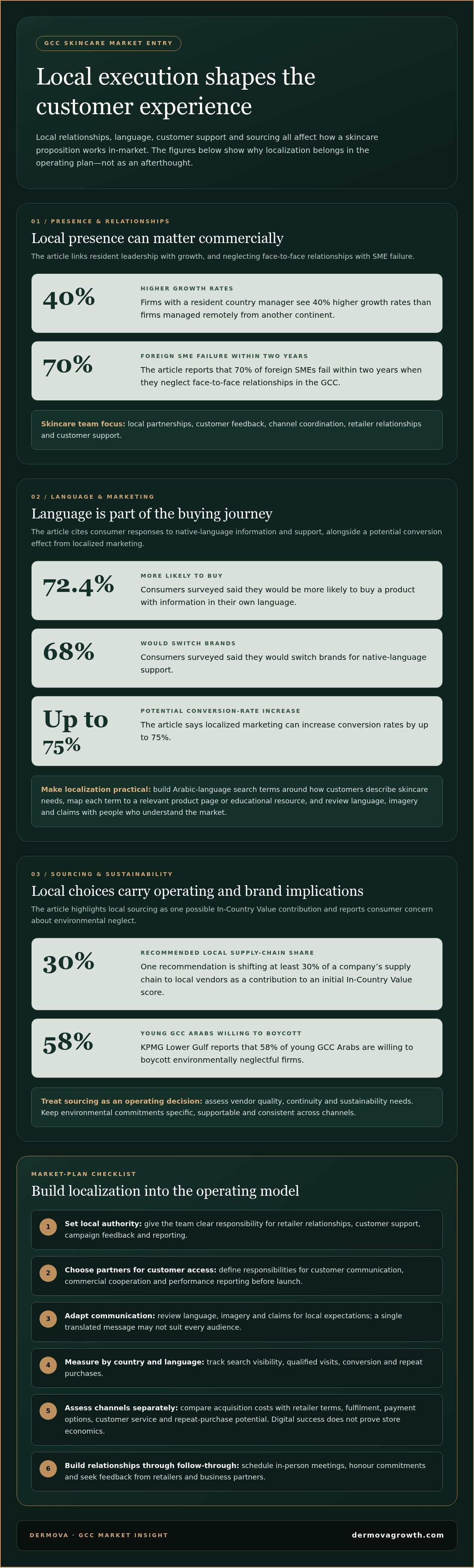
- Develop a Localized Marketing Strategy
Skincare marketing should reflect the product, the intended customer, the purchasing channel, and the requirements of each market.
A regional strategy can provide consistency, but execution should be adapted where evidence indicates that customer needs or channel conditions differ.
Adapt Language and Product Education
Arabic and English content may both be relevant, depending on the target audience and channel.
Localization should go beyond translation. Product benefits, ingredient explanations, usage guidance, visual choices, and customer support should be appropriate for the intended audience.
All product claims should remain consistent with supporting evidence and applicable rules.
Match Content to the Customer Journey
Different content formats serve different commercial purposes.
Educational content can help customers understand ingredients and routines. Product pages can explain benefits, usage, and suitability. Customer reviews may help answer purchasing questions when collected and presented appropriately.
Paid campaigns can test demand and messaging, while email or other permitted customer communications can support retention.
Each activity should have a defined purpose and measurable outcome.
Measure Commercial Performance
Track relevant indicators by country and channel, such as:
- Qualified website traffic.
- Product-page engagement.
- Conversion rate.
- Customer acquisition cost.
- Average order value.
- Contribution margin.
- Repeat purchase rate.
- Retail sell-through and replenishment.
- Distributor performance against agreed commitments.
Reach, impressions, and engagement can provide useful context, but they do not establish commercial success on their own.
Use the results to decide whether to improve the proposition, adjust pricing, change the channel, or increase investment.
- Select and Manage Local Partners Carefully
Local partnerships can support market access, but the quality of a partnership depends on defined responsibilities and measurable commercial value.
Qualify Potential Partners
Evaluate potential partners against the brand's actual requirements.
Ask about their category experience, relevant customer access, channel coverage, existing portfolio, operating capabilities, and willingness to commit resources.
Request evidence where appropriate, such as relevant account references, distribution coverage, and examples of comparable work.
Distinguish between a company that can make introductions and one that can execute a distribution or sales strategy.
Agree on Responsibilities Before Launch
A clear commercial arrangement should identify:
- The territory and channels cove